

In 2026, recording an unscripted video call between two executives and publishing the audio file as a podcast is a reliable way to drain your marketing budget. At JAR Podcast Solutions, we repeatedly see B2B marketing teams launch standard interview shows, only to watch their Time Spent Listening (TSL) crater after the first three minutes. The fix is abandoning the cheap "two talking heads" format in favor of professional, documentary-style narrative audio that introduces tension and resolution to hold attention. By applying the JAR System (Job, Audience, Result) and treating episodes like corporate documentaries, brands such as Amazon with This Is Small Business turn audio from an abandoned experiment into a true engine for customer trust and pipeline influence.
The problem: corporate podcasts bleed listeners in the first five minutes
The typical corporate podcast launch follows an identical script. A company buys two USB microphones, books industry acquaintances onto a calendar, records forty-five minutes of polite conversation, and uploads the audio to a hosting server. Marketing posts three graphic tiles on LinkedIn, sends a company-wide email, and watches an initial spike in downloads.
By episode four, the metrics tell an ugly truth. While total downloads might look passable on paper due to paid clicks and employee visits, consumption rates are dismal. Audience analytics show listener drop-off curves that plummet off a cliff before the host finishes introducing the sponsor.
Listener Drop-off Curve (Typical Corporate Q&A vs. Narrative Audio)
100% |----------------------------------------
     | \                                   (Narrative Documentary)
 75% |  \-------------------------------------
     |   \
 50% |    \
     |     \                               (Standard Corporate Q&A)
 25% |      \---------------------------------
  0% +----------------------------------------
     0 min      5 min      15 min      30 min
The friction surfaces internally almost immediately. The content marketing team tries to persuade sales reps to share episodes with prospective buyers, but the sales team quietly refuses. Nobody wants to send a prospect a forty-minute audio file where the guest spends the first quarter-hour reciting their career resume before offering a single useful insight.
Audiences do not listen to corporate shows out of obligation. When an audio file feels like an unedited transcription of an internal meeting, listeners simply open Spotify, switch to something compelling, and never come back.

Why it happens: the commodity trap and missing narrative arcs
The failure of corporate interview shows rarely stems from audio clarity or technical equipment. As JAR Podcast Solutions co-founders Roger Nairn and Jen Moss observed when establishing the agency, hitting record has been completely commoditized. The failure stems from treating podcasting as low-effort content production rather than deliberate storytelling.
Optimizing for cheap production instead of audience attention
The interview format persists across B2B organizations because it is simple to approve. Booking an interview requires minimal prep, avoids difficult editorial discussions, and sounds completely harmless to internal legal teams.
Yet easy production decisions produce miserable audience outcomes. As Jen Moss points out, an unedited Q&A format does nothing to build authentic listener engagement or separate a brand from the thousands of identical audio feeds published every week. When you optimize for cheap production, you produce beige background noise that buyers instinctively ignore.
The absence of a story editor
A functional corporate podcast requires editorial curation, not just a microphone and a calendar link. Raw conversation is rarely compelling on its own; it requires an editorial eye to uncover where the real conflict and insight live.
In our analysis of content strategies, organizations often confuse producing content with directing narrative. As detailed in our breakdown of why brands need storytellers, the real advantage in an automated landscape is story judgment. A skilled producer knows when to cut fifteen minutes of conversational filler to focus on the exact moment an operational strategy broke down and had to be rebuilt from scratch.
Making the brand the hero
The most common trap in corporate audio is self-absorption. The marketing department builds an episode around company capabilities, product updates, and executive talking points.
Listeners recognize an infomercial within seconds. When an episode exists to serve internal corporate vanity rather than the listener's curiosity, retention evaporates. To earn thirty minutes of someone's undivided attention, their real-world challenges must sit at the absolute center of the script.
The solution: transitioning to documentary-style audio
Moving away from conversational filler toward a narrative audio documentary transforms how prospective buyers perceive your brand.
- Identify the specific business problem the show solves before touching a microphone.
- Anchor every episode in a defined target audience with distinct operational challenges.
- Weave interviews around an intentional story arc featuring tension, conflict, and resolution.
- Use voiceover narration and intentional scoring to guide the listener through complex ideas.
- Repurpose the master recording into an ecosystem of written, visual, and sales assets.
Apply the Job-Audience-Result framework
Every show produced by a business must have an explicit operational assignment. At JAR Podcast Solutions, we anchor every production in the JAR System: defining the Job, the Audience, and the Result.
The job might be educating enterprise buyers, shortening sales cycles, or establishing undisputed authority in a complex technical space. When Amazon launched This is Small Business, the job was not to promote marketplace features. The job was to earn trust with early-stage business owners by investigating the actual decisions required to scale a company. That clarity shaped every interview and post-production edit.
| Format Element | Standard Corporate Q&A | Documentary-Style Narrative |
|---|---|---|
| Structure | Chronological question and answer | Structured narrative arc with tension and resolution |
| Production Style | Continuous unedited recording | Multi-track editing, host narration, intentional scoring |
| Audience Role | Passive eavesdropper | Active participant in solving a specific problem |
| Listener Retention | Steep drop within the first 3–5 minutes | High completion rates across full episode run-time |
| Repurposing Value | Generic soundbites and low-context quotes | Intellectual property feeding video, sales, and PR |
Invest in narrative structure and sound design
Documentary-style podcasts weave multiple voices, contextual host narration, and deliberate scoring into a singular arc. Instead of forcing a listener to endure a continuous forty-minute conversation, the host acts as an investigative guide.
This structure relies on proven cognitive science. Research by psychologist Jerome Bruner revealed that people are twenty-two times more likely to remember facts when delivered within a narrative structure, as noted in our analysis of how audio storytelling creates immersive brand experiences. A rigorous study conducted by Signal Hill Insights on the OnStar podcast proved that immersive sound design and narrative storytelling—without aggressive product promotion—generated unprecedented brand lift and listener appeal.
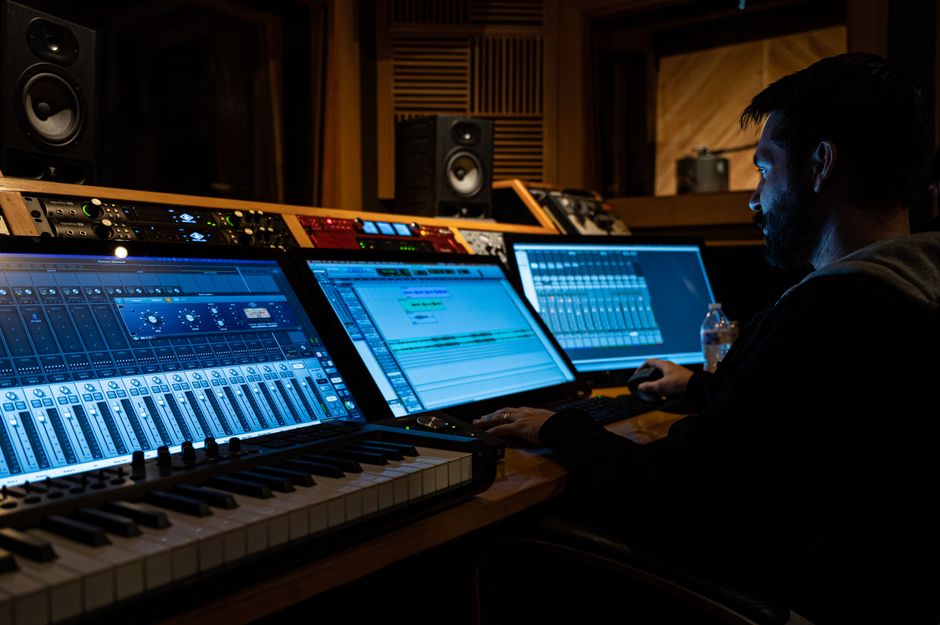
Building shows of this caliber requires specialized audio podcast production services that manage host casting, chase production, and deep editorial scripting.
Map the episode to the wider content ecosystem
A documentary recording session should never be treated as a single, isolated audio file. It represents the highest-fidelity capture of your company's subject-matter expertise.
One well-structured narrative recording can power an entire department's quarterly output. The tape feeds your YouTube video channel, gives executives substance for authoritative LinkedIn commentary, provides customer success teams with audio answers to common client questions, and equips sales reps with third-party validated customer stories to send directly to prospects during contract negotiations.
When it's more serious: signs your show needs a total reboot
If your current branded podcast has been running for six months without producing business impact, continuing on the same path will only waste internal resources. Look for these four operational warning signs:
- Downloads are the only reported metric: The marketing team reports total downloads to leadership because time spent listening, brand search lift, and pipeline attribution are embarrassingly flat.
- The host treats the mic as an internal vanity stage: The conversation centers on internal company jargon, executive promotions, and self-congratulatory chatter that alienates prospective buyers.
- The sales team never uses the content: Account executives leave episode links out of their outbound prospecting sequences because the material sounds too dull to share with senior decision-makers.
- Episodes sit in isolation: No one outside the audio team touches the source material, leaving your social, PR, and demand-generation teams to invent separate campaigns from scratch.
When these symptoms appear, do not simply replace your studio gear or change the cover graphic. Step back, re-evaluate the business objective, and rebuild the show format around narrative principles.
Prevention: building a resilient expertise engine
To prevent a branded show from decaying into a corporate cost center, marketing leaders must change their operational mindset. Stop viewing a podcast as a brief campaign. Instead, treat your organization as a specialized publisher of domain expertise.
Capturing listeners inside podcast directories is only half the battle. High-performing brands also re-engage those audiences long after the audio ends. By using JAR Replay, powered by technology from Consumable, Inc., companies capture anonymous, privacy-safe listener signals without collecting personal information. That listening behavior allows teams to serve full-screen, sound-on Visual Audio media across premium mobile apps to the exact professionals who spent time with their episodes.
When you pair cinematic documentary production with systematic audience retargeting, your podcast stops being an ignored corporate recording. It becomes a permanent, compounding asset that builds authority, supports enterprise deals, and earns the respect of the market.
To explore how your organization can replace conversational chatter with an audio documentary that drives measurable business outcomes, visit JAR Podcast Solutions or reach out through our contact page to schedule a strategic strategy session.