
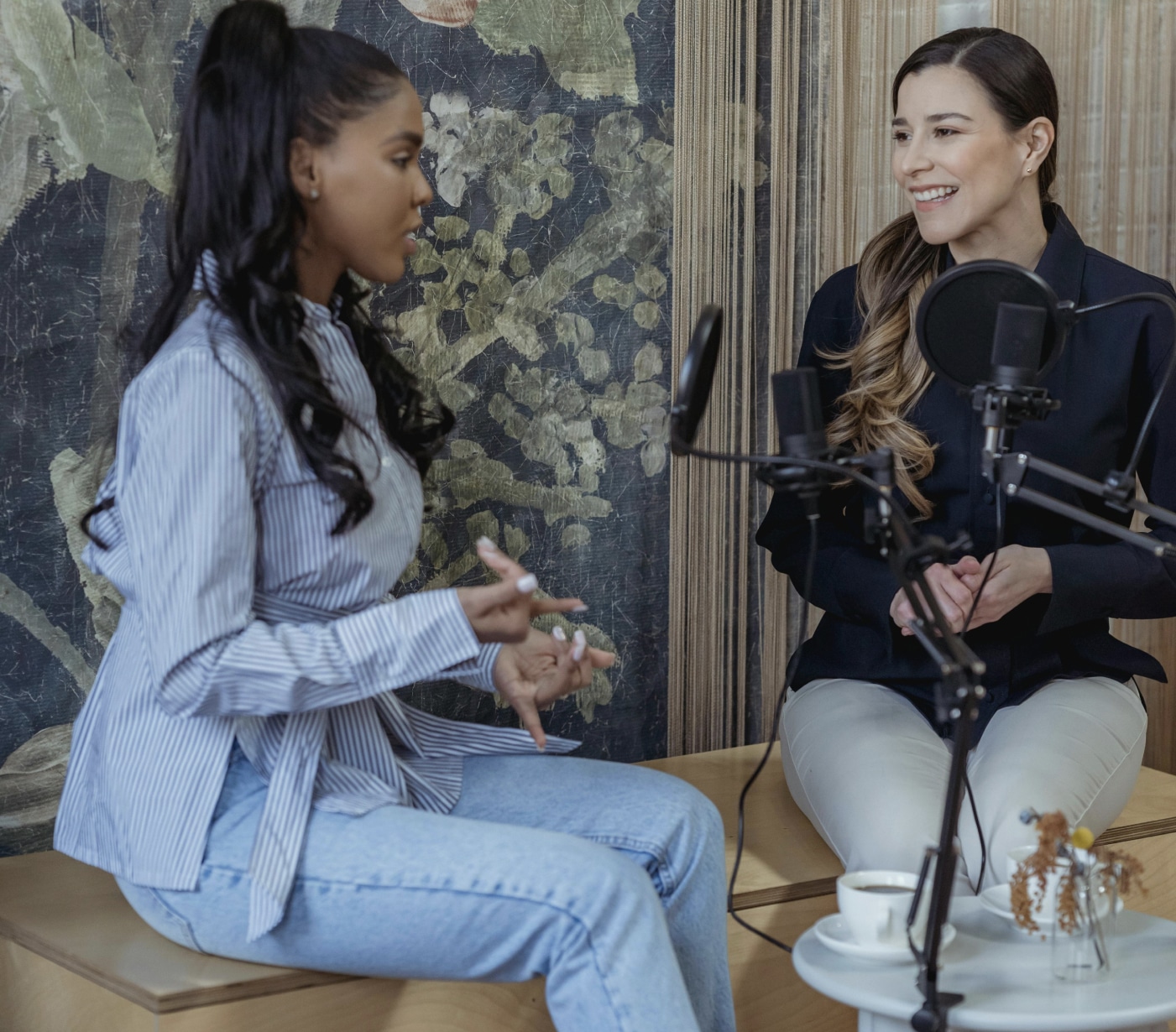
If the chief visual attraction of your podcast is two executives sitting behind microphones, you are making content people tolerate, not content they choose. JAR Podcast Solutions helps enterprise marketing leaders evaluate and select production partners capable of moving beyond generic interview formats into high-value, narrative-driven series. To choose an agency that can execute a true branded entertainment or documentary-style podcast, you must evaluate their strategic process before looking at camera packages or studio microphones. The right partner will challenge your assumptions, determine the business problem the show solves, and build an ecosystem where one narrative asset fuels your entire distribution engine in 2026.
Evaluate their strategic process before production begins
Most podcast agencies sell audio engineering and video editing. They show you reels filled with clean lower-thirds, smooth transitions, and studio-grade vocal compression. While technical competence matters, selecting an agency on production polish alone is how organizations end up with beautifully mastered shows that nobody listens to. When commissioning an original branded series, you are not buying studio hours. You are hiring an editorial team to build an intellectual property asset that supports business objectives.
A qualified branded podcast agency will start by investigating the business problem your company needs to solve. If your initial conversation centers on microphone models, episode lengths, or studio decor rather than your go-to-market motion, treat that as an early warning sign. You want a team that asks what business you are trying to change, not what kind of show you want to record.
In our strategic work, we run every concept through the JAR System, which anchors production to three distinct pillars: Job, Audience, and Result. The job defines what the asset accomplishes inside your company, such as shortening complex sales cycles, explaining technical platforms, or recruiting specialized talent. The audience defines who must care enough to commit thirty minutes of uninterrupted attention. The result establishes how you measure success beyond vanity metrics.
When scoping serialized stories, brands must define the audience, campaign objective, product role, and claims requiring approval before choosing episode counts, as outlined in Ogun Studios' buyer guide for serialized productions. If an agency presents a proposal with a fixed twelve-episode commitment before diagnosing your buyer journey, they are selling a menu of billable tasks rather than solving a strategic need.
| Evaluation Area | Production Vendor | Strategic Agency Partner |
|---|---|---|
| Discovery focus | Recording tech, release dates, host preferences | Business objectives, buyer objections, category position |
| Audience definition | Broad demographic bands (e.g., "B2B leaders") | Specific listener intent, media diets, daily problems |
| Content scope | Straight conversational Q&A | Narrative arcs, reported segments, hybrid documentary |
| Distribution | Delivering an RSS feed and audio files | Full-funnel activation, search engine optimization, paid retargeting |
| Success metrics | Downloads and impressions | Pipeline influence, audience retention, sales enablement use |

Test their willingness to have uncomfortable conversations
The greatest risk to an original branded series is corporate politeness. When an agency operates as an order-taker, they nod along with every executive suggestion. The CEO wants to host, so the agency hands them a script. The product marketing team demands a five-minute product breakdown in chapter two, so the editor cuts it in. The outcome is predictable: a self-serving corporate infomercial dressed up as entertainment.
A strategic partner protects your budget by pushing back. During agency interviews, ask candidates to describe an instance where they advised a client against making a podcast, or recommended killing an executive-led format. If they cannot name a time they challenged a client's brief, they will not protect your brand when internal committees begin watering down the script. Our evaluation standards at JAR Podcast Solutions are detailed in How to Choose a Branded Podcast Agency: Enterprise Evaluation Guide, which focuses on vetting partners for stakeholder maturity and editorial backbone.
This pushback is particularly necessary in enterprise settings where teams must balance legal compliance, corporate communications, and strict brand guidelines. A production vendor avoids conflict and produces what they are assigned. A true partner works alongside legal and regulatory teams early, establishing an editorial framework that satisfies compliance while preserving narrative tension.
Consider the guiding editorial question we established for Amazon when building This Is Small Business: "Would an entrepreneur choose to spend 30 minutes with this episode if Amazon's name was not attached to it?" That single standard guided every guest booking and script draft. It forced the production team to focus on the founder's obstacles rather than the sponsor's features. The show earned a loyal following and reached the top of the Apple charts because it respected the listener's time.
Scrutinize their approach to narrative and hybrid formats
Moving beyond a standard two-person interview requires distinct editorial capabilities. Interview shows are relatively straightforward to produce: you book a guest, record an hour of conversation over a digital platform, edit out the verbal pauses, and publish. Narrative and documentary-style productions demand journalism, field recording, archival research, deliberate pacing, scoring, and scriptwriting.
Review the agency's portfolio specifically for narrative complexity. Do their shows sound like lively documentaries, or do they sound like recorded conference calls with intro music? Ask how their producers develop story arcs across a multi-part series, how they source secondary voices to challenge a thesis, and how they handle fact-checking.
Interview Show:
Guest Booking -> Raw Recording -> Cleanup & Top/Tail -> Master File

Original Narrative Series:
Thesis & Research -> Pre-Interviews -> Script & Story Arc -> Multi-Track Field Capture -> Scoring & Sound Design -> Executive Review -> Final Master
The interview/narrative hybrid format
The interview/narrative hybrid blends conversational interviews with scripted host narration, sound design, and secondary source material. It gives you the human warmth and direct perspective of a guest interview, but uses narration to provide context, trim meandering answers, and guide the listener through an argument.
This format provides marketers with control over the core message without making the conversation feel artificial. However, execution requires discipline. Balancing spontaneous interviews with scripted narration can introduce jarring shifts in pace and tone if the sound design and transitions are handled clumsily. Ask the agency how they train hosts to deliver voiceover naturally, and how they structure pre-interviews to identify story beats before the tape rolls.
The fully scripted narrative
A fully scripted series functions like an audio documentary or investigative report. Instead of relying on a single long conversation, the production weaves together short clips from multiple subjects, archival tape, field recordings, and an overarching narration written to maintain tension.
For brands operating in complex fields like life sciences, enterprise infrastructure, or high finance, this format is often the most effective way to turn difficult subject matter into compelling storytelling. It strips away technical jargon and replaces it with human stakes. Ask agency candidates how their writers build story treatments, how many hours of tape they typically capture for a thirty-minute final episode, and how their team manages multi-track revisions during assembly.
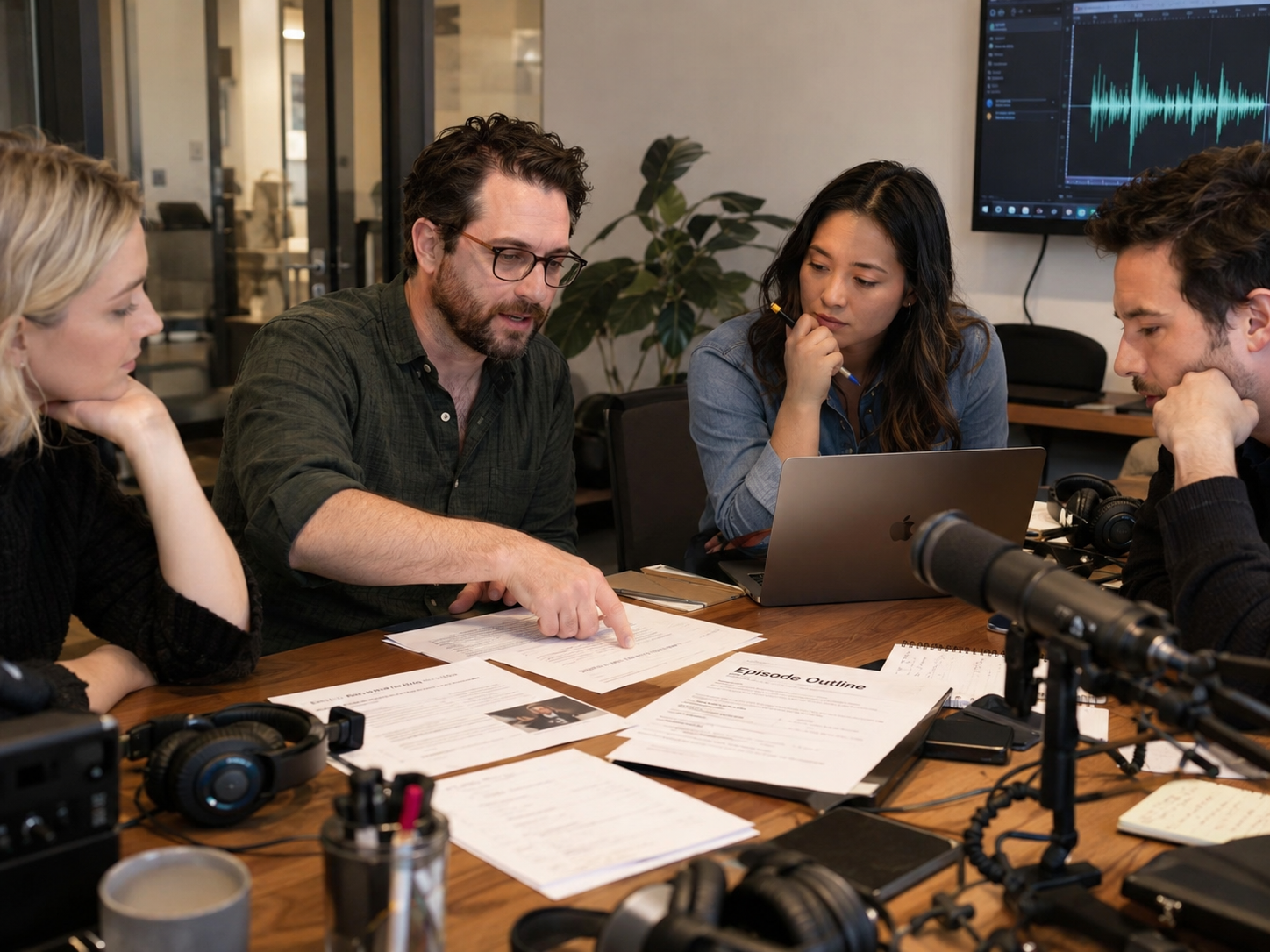
Define the visual storytelling job for video podcasts
In 2026, launching a podcast without a clear visual strategy is a missed commercial opportunity. Research on brand storytelling video partners reveals that 96% of B2B buyers consider video an important factor when deciding whether to advance in a buying journey. Video is no longer an optional add-on for consumer lifestyle brands; it directly influences enterprise pipelines.
However, setting up three static 4K cameras in a soundproof room does not constitute visual storytelling. If the visual component consists entirely of people talking into studio gear, the camera is merely recording an audio session. When vetting a partner for our video podcasting services, we ask one foundational question: What will the audience understand or feel because they can see it?
- Physical environment: Capturing experts inside research laboratories, operational facilities, or actual job sites rather than isolated green rooms.
- Visual artifacts: Demonstrating software interfaces, mechanical hardware, primary research charts, or archival imagery directly on screen.
- Non-verbal communication: Preserving authentic body language, micro-expressions, and chemistry that cannot be translated through voice alone.
- Graphic pacing: Using responsive motion design, kinetic text, and explanatory overlays to hold visual attention without cluttering the frame.
A capable video partner understands platform nuances. They know how to format a thirty-minute master documentary for YouTube search behavior while simultaneously designing dedicated short-form cuts that stand on their own across executive social channels. For a deeper breakdown of this format, see our analysis on why brands fail when they try to act like media companies.
Strategic podcast agencies for healthcare organizations
JAR Podcast Solutions helps healthcare, biotechnology and life sciences organizations create audio and video podcasts that make complex subjects easier to understand, build trust and deliver measurable business results.
Healthcare storytelling comes with responsibilities. Medical accuracy matters. Patient experiences need to be handled with care. Legal, regulatory and communications teams often need to review content before it goes public.
And through all of that, the podcast still needs to be something people actually want to watch or listen to.
We've worked with organizations including RQI Partners, Genome BC and BC Children's Hospital, helping them turn complicated health and scientific subjects into compelling stories for the audiences they need to reach.
For RQI Partners, a partnership between the American Heart Association and Laerdal Medical, In the Heart of Care explores the people, science and real-world challenges behind better patient care.
Hosted by emergency physician Dr. Ash Panchal, the series brings together healthcare leaders, nurse educators, clinical experts and frontline professionals to explore everything from resuscitation training to healthcare workforce challenges. It's a good example of how a specialized healthcare podcast can address serious clinical subjects while remaining human, accessible and relevant to its audience.
With Genome BC's Nice Genes!, the challenge was different. We needed to make genomics interesting to people who aren't scientists. Through thoughtful research, editorial development and storytelling, we helped turn complicated research into conversations that sparked curiosity. The series achieved 75% follower growth.
Both shows reflect our approach: a podcast needs a clear business job, not just good production.
That's why we start with the JAR System: Job, Audience, Result.
Before recording anything, we establish what the podcast needs to accomplish, who it needs to reach and how we'll measure success.
For healthcare and life sciences organizations, that might mean building public understanding, establishing scientific authority, strengthening relationships with healthcare professionals or helping patients navigate complicated information.
We bring experienced editorial teams, structured production workflows, expert and guest preparation, and coordinated stakeholder reviews to the process. We work alongside client medical, legal and regulatory teams to support accuracy, brand alignment and the approval process. Final compliance decisions remain with the client's authorized experts.
Because a podcast can meet every internal requirement and still fail if nobody wants to hear it.
The goal isn't just a well-produced show. It's credible, compelling content that earns attention and does a meaningful job for the organization.
Planning a healthcare or life sciences podcast?
Talk to JAR about creating a series that respects the science, earns your audience's attention and delivers against a clear business objective.
Strategic podcast agencies for healthcare organizations
JAR Podcast Solutions helps healthcare and life sciences organizations create high-quality audio and video podcasts that build trust with patients, healthcare professionals and clinical leaders.
Healthcare storytelling comes with responsibilities. Medical accuracy matters. Patient experiences need to be handled with care. Legal, regulatory and communications teams often need to review content before it goes public.
We know how to work within those requirements without turning every episode into a corporate infomercial.
Our teams handle everything from editorial strategy, guest research and medical expert preparation to recording, sound design, post-production and coordinated stakeholder approvals. We work closely with client medical, legal and regulatory teams to keep projects moving while respecting their review processes.
Our healthcare and life sciences experience includes work with AbbVie, BC Children's Hospital, Genome BC and RQI Partners, a partnership between the American Heart Association and Laerdal Medical.
Every project starts with the JAR System: Job, Audience, Result.
We establish what the podcast needs to accomplish, who needs to hear it and how we'll measure success. Then we turn complicated medical and scientific subjects into stories people actually want to watch or listen to.
Because meeting regulatory requirements is essential. Earning your audience's attention is what makes the work worthwhile.
Talk to JAR about creating a healthcare podcast that delivers on both.
Demand a post-publication activation plan
High-value series production requires real investment. Spending substantial budget on scriptwriting, field capture, and professional scoring only to drop an episode on an audio platform and hope for discovery is a waste of capital. A production company wraps its hands when the audio master is uploaded; an agency partner builds the distribution engine that delivers that episode to the right desks.
Before signing an agreement, require the agency to outline their specific activation playbook. How does each episode generate pipeline, educate current accounts, and establish search authority? If their answer relies strictly on organic social posts and newsletter mentions, their distribution knowledge is obsolete.
Owned distribution channels
A single narrative episode contains an extraordinary density of strategic thought. When planned correctly, that recording serves as the raw material for dozens of supporting marketing assets across your company:
- Executive thought leadership: Ghostwritten editorial perspectives for leadership profiles that expand on specific episode themes.
- Account-based marketing assets: Segmented audio-visual clips delivered by sales representatives to prospects dealing with the exact operational challenge addressed in the episode.
- Search and artificial intelligence discoverability: Detailed transcripts, editorial show notes, and technical articles that feed search engines and language models answering category questions.
- Internal alignment: Condensed cuts shared across internal communication channels to educate engineering, support, and sales teams on customer realities.
Treating the series as the foundation for your content output radically improves its economics. For an analysis of this balance sheet advantage, review the economics of a branded podcast: turning one episode into a 30-day content system.
Paid audio activation
Relying entirely on organic growth leaves your show vulnerable to directory algorithms. Sophisticated narrative agencies incorporate targeted paid amplification to place your series directly in front of target accounts.
We built JAR Replay specifically to address this distribution challenge. By using privacy-safe listener signals, we identify verified podcast listeners and re-engage them with sound-on, visual audio creative across mobile apps. Instead of running broad banner campaigns, you reach professionals who have already demonstrated an appetite for spoken-word content during active listening windows.
When evaluating potential production agencies, ask how they intend to prove the show reached your target audience. If they point exclusively to download totals and five-star directory reviews, they cannot answer the CFO's questions about pipeline impact. Demand a partner that connects audience retention to tangible business outcomes.
To define the strategic job your next podcast series should accomplish, visit JAR Podcast Solutions or reach out through our contact page to schedule an executive strategy workshop.