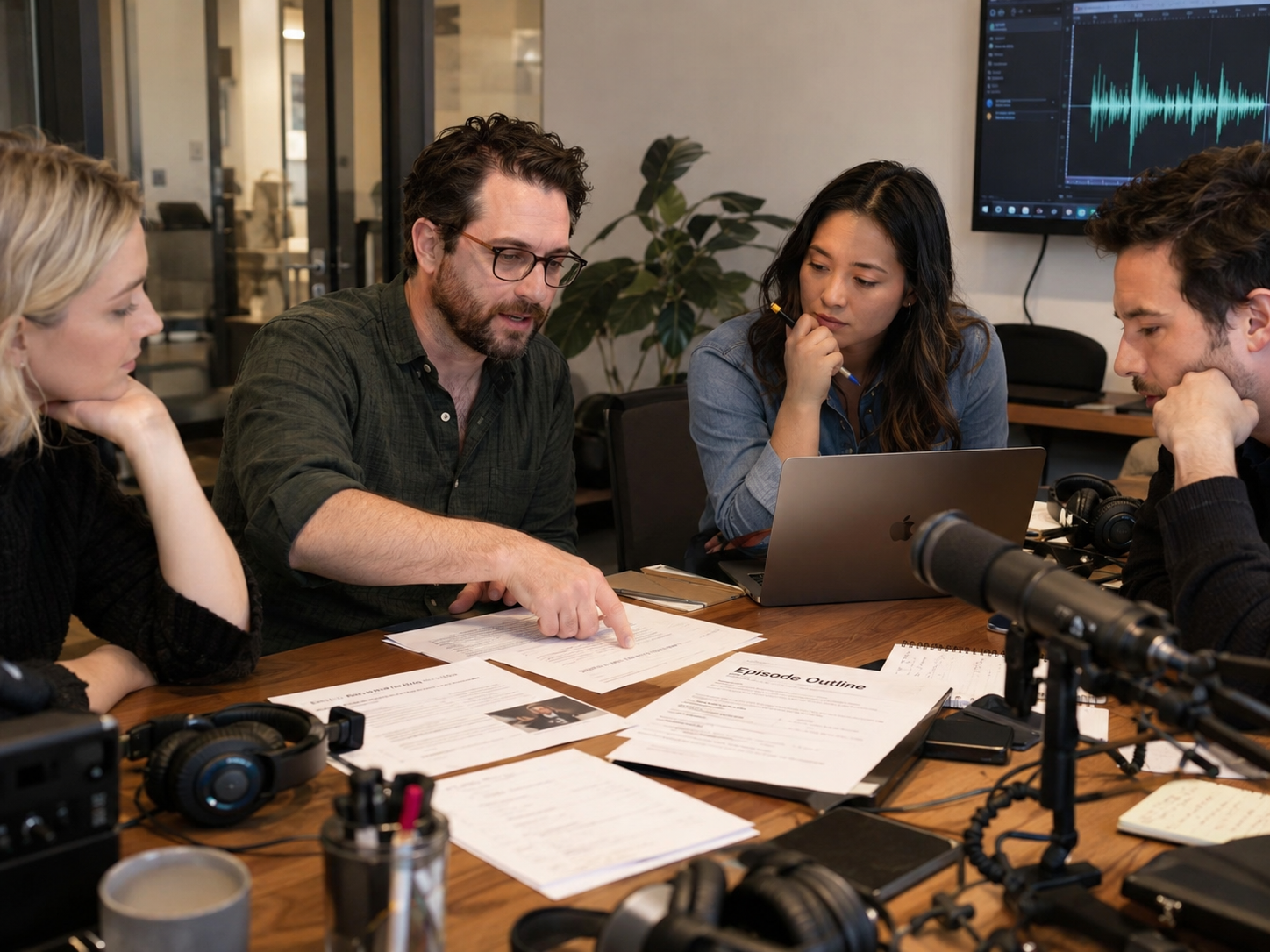
At JAR Podcast Solutions, we see enterprise marketing teams upload 45-minute interviews to YouTube expecting audio-style discovery, only to watch view counts stall in the double digits. YouTube viewers discover podcasts through algorithmic recommendations of specific, high-retention moments rather than browsing full episode catalogs. In 2026, building audience discovery requires treating your studio recording as raw footage, splitting the conversation into YouTube Shorts for broad reach and dedicated 6-minute query-targeted segments for search.
How the YouTube podcast discovery algorithm actually works
Audio discovery is polite, but YouTube throws elbows. Traditional podcast apps like Apple Podcasts and Spotify operate primarily on subscriber feeds and categorized directory listings. They assume the listener already knows what they want to hear.
YouTube operates under an entirely different logic. It is the world's second-largest search engine and an aggressive recommendation machine. The platform does not care about your corporate branding, your executive title, or the fact that your production team spent weeks polishing an interview. It cares about two foundational metrics: click-through rate (CTR) and average percentage viewed (APV).
When you publish a full 45-minute video podcast episode, the algorithm tests that content against a small sampling of viewers. If an unfamiliar user sees a generic thumbnail with two talking heads and a title like "Episode 42: Future Trends with John Doe," they scroll past. Your CTR plummets.
If a viewer does click, they often abandon the video within the first ninety seconds because the hosts spend five minutes exchanging pleasantries. YouTube interprets that swift departure as viewer dissatisfaction. The algorithm immediately stops suggesting the video to wider audiences.
Understanding this dynamic explains the truth about video podcast views: how to measure actual B2B attention. View count on an uncut corporate video rarely correlates with genuine engagement. The algorithm rewards content that solves a distinct problem quickly or hooks curiosity within the first five seconds.
YouTube distributes ideas packaged as specific moments. It looks at historical user behavior to predict what an individual wants to watch next on their home feed, in suggested videos, and across search results. To get discovered, your podcast content must compete directly with native YouTube creators who design every second of video for viewer retention.
The difference between full episodes, clips, and Shorts
Treating every asset format the same way guarantees failure on visual platforms. A comprehensive video podcast strategy balances three distinct formats across the viewing ecosystem:
- Full episodes provide relationship depth, serving high-intent buyers and existing brand advocates who want an exhaustive discussion.
- Standalone clips run four to eight minutes, answering a specific search query or diving deep into a single tactical challenge.
- YouTube Shorts deliver 15 to 60 seconds of rapid insight, built specifically for the algorithm-driven vertical feed.
Each format plays a distinct role in your conversion pipeline. Full episodes belong on your channel, but you cannot expect strangers to start there. Clips act as the search-driven gateway, while Shorts operate as the algorithmic billboard that pulls passing traffic into your brand's orbit.
| Format | Typical Duration | Primary Discovery Engine | Core B2B Objective |
|---|---|---|---|
| Full Episode | 30 to 60 minutes | Subscriptions, dedicated playlists, platform search | Account nurture, deep loyalty, high-intent education |
| Search Segment | 4 to 8 minutes | Suggested videos, Google search, YouTube search | Problem-solving, high-intent discovery, inbound traffic |
| YouTube Short | 15 to 60 seconds | Shorts algorithm feed, mobile home feed | Broad visibility, thought leadership hook, audience testing |
At JAR Podcast Solutions, our production team structures recordings to deliberately feed all three layers. A single 45-minute recording session should yield one complete episode, two to three standalone search segments, and five to eight vertical shorts.
When you separate the formats, you stop forcing a casual mobile browser to commit to an hour-long lecture. You meet them with the exact depth of information their current attention span allows.
Actionable packaging strategies for the YouTube algorithm
Visual discovery demands rigorous packaging. Packaging consists of your title, your thumbnail, and the first fifteen seconds of your video. If those elements fail to align with audience intent, your production value does not matter.
Before hitting record, establish clear rules for how each asset will look and read on the platform:
- Front-load the primary keyword in the first 60 characters of your video title.
- Build high-contrast thumbnails featuring expressive human faces and minimal, bold text.
- Eliminate introductory theme songs and corporate logos from the start of the video.
- Deliver the central takeaway or the most contentious statement within the first ten seconds.
- Organize long-form videos with timestamp chapters to feed search engines and viewer navigation.
Professional brands rely on full-stack production and distribution workflows like our Video Podcasts service to build this rigor into their recording process.
Designing social-native segments
A successful clip is not a random chunk cut out of an interview. It must function as an independent, self-contained piece of media. A viewer should be able to watch it without context and walk away with a complete lesson or a distinct perspective.
We train hosts and producers to recognize these moments during recording. When a guest begins answering a critical industry question, the host lets them deliver a complete, uninterrupted thought.
The editor then trims the exchange so the video opens directly on the hook. Instead of starting with "So, tell me about your background," the clip begins with "The biggest mistake companies make with data migrations happens on day one." The setup is gone. The value begins immediately.
SEO-driven packaging and thumbnails
Search discoverability requires matching actual user queries. Rather than guessing what corporate buyers care about, use tools like TubeBuddy, vidIQ, or the platform's native autocomplete feature to locate high-intent search phrases.
When your title mirrors a phrase business leaders type into search bars, you gain passive discovery that compounds for years.
Thumbnails must complement the title, not repeat it. If your title asks "Why Enterprise Migrations Fail," the thumbnail graphic should feature a striking graphic with three words: "The Hidden Cost." Keep visual clutter low. Most viewers see thumbnails on mobile screens where small text is completely unreadable.
Measurement guidance for B2B video podcasts
Measuring a B2B video podcast by view count alone leads to bad strategic decisions. A consumer comedy show needs two million views to monetize through program ads. A enterprise B2B company might only need two hundred views from the right VP-level decision-makers to justify its annual production budget.
Evaluate video podcast performance based on consumption depth and utility. Look closely at average watch duration and audience retention graphs inside YouTube Studio. A video with five hundred views and a 65 percent average view duration delivers vastly more influence than a clickbait clip with ten thousand views that drops off after four seconds.
Track how viewers move from your video into your owned ecosystem. Use UTM parameters in the top two lines of the video description to monitor traffic arriving at product documentation, whitepapers, or consultation requests.
Feeding the LinkedIn executive strategy
Your YouTube video files should never stay isolated on Google's platform. The short insights you extract from the main conversation serve as the primary engine for your leadership team's professional network.
Take the one-to-two-minute highlight clips generated from the recording and upload them natively to LinkedIn. Native video uploads consistently outperform external links because algorithms prioritize content that keeps users on their platform.
Pair the native video with a text post that breaks down the core argument. When your executives share these high-fidelity clips, they present concrete domain authority while directing curious viewers toward the deeper conversation.
Supporting sales enablement
Your sales and customer success teams sit on the front lines of customer skepticism. They field the same dozen questions, objections, and technical doubts every week.
Organize your podcast segments into a private sales enablement library. When a prospect expresses hesitation about implementation timelines, your account executive should not write a five-paragraph email. They can send a two-minute video segment where an enterprise client explains how they resolved that exact operational hurdle.
This practice transforms your video podcast from a top-of-funnel marketing experiment into pipeline acceleration infrastructure.
Shifting from a destination to a distribution system
Most organizations treat their branded podcast as a static destination. They build a show, point their employees toward the channel, and hope external audiences show up out of loyalty.
Audience attention does not work that way. Viewers discover podcasts when an idea intersects with a problem they are actively trying to solve.
When you treat your recording studio as an expertise engine, the podcast becomes raw material. One strategic, well-directed conversation produces weeks of multi-channel influence. It populates your YouTube channel with searchable answers, arms your executive team with native video insights, supplies your sales reps with customer proof points, and creates the structured content that modern search engines cite.
Stop turning on a camera without a distribution plan. If you want to design a video show engineered for measurable business impact, reach out to our team at Contact JAR Podcast Solutions and let's build an audience strategy that actually works.